Why Strength Training is One of the Most Important "Medications" for Your Muscles
June 1, 2026
Categories: Wellness, Rehabilitation Services
Tags: Exercise, Strength Training
The American College of Sports Medicine (ACSM) recently updated its major position statement on resistance training. This update is based on a large “overview of reviews,” meaning it combines findings from 137 high-quality research reviews involving over 30,000 people. The goal was to answer a simple question:
What actually works best to improve strength, muscle size, and physical performance in healthy adults?
Lifting Weights Works - Consistently
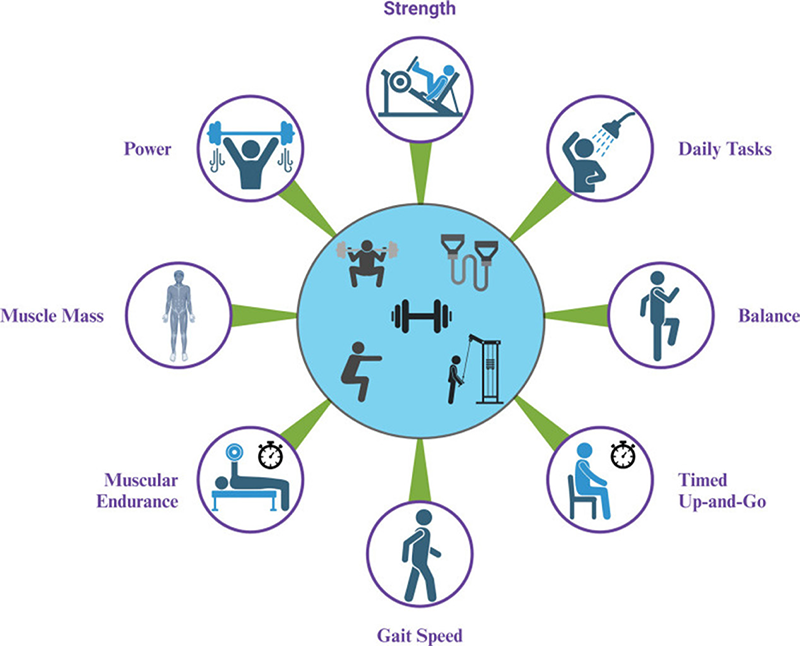
Across all studies, resistance training (strength training) was shown to significantly improve:
- Muscle strength
- Muscle size (hypertrophy)
- Power (explosive strength)
- Endurance and movement speed
- Balance, walking ability, and daily function
In short: strength training improves not just muscle size, but how well you move and function in daily life! One of the most important findings is that nearly all forms of resistance training are effective compared to doing nothing.
This includes:
- Free weights
- Machines
- Bands
- Bodyweight training
- Home-based programs
The most important factor is consistent progressive training, not a perfect program.
What Matters Most in Training?
While many program details are flexible, the research highlights a few variables that consistently matter:
1. To Get Stronger
Strength improves best when you:
- Lift heavier loads (about 80%+ of your max effort)
- Train through a full range of motion
- Do 2–3 sets per exercise
- Train muscles at least 2 days per week
2. To Build Muscle Size
Muscle growth is driven more by total workload rather than heavy weight alone:
- Around 10+ sets per muscle per week is a strong target
- Higher total training volume generally leads to more growth
- Both moderate and heavy weights can build muscle if effort is high
3. To Improve Power (Explosiveness)
Power improves best with:
- Moderate weights (not too heavy or too light)
- Fast, explosive lifting speed
- Lower to moderate total volume
- Olympic-style or “fast intent” lifting movements
This type of training also helps improve physical performance like walking speed, stair climbing, and sport movements.
What Matters Less Than Most People Think
The research found that several commonly debated variables do NOT consistently change results, including:
- Training to complete muscle failure every time
- Specific equipment type (machines vs free weights)
- Complex exercise variations
- Exact set structure or timing methods
- Periodization styles (in many cases)
In other words: consistency and effort matter more than highly specific programming details.
The Simplest Evidence-Based Recommendation
For healthy adults, the ACSM concludes: “Perform progressive resistance training at least 2 times per week, training all major muscle groups with challenging effort.”
If you do that consistently, you will improve:
- Strength
- Muscle size
- Power
- Everyday physical function
Strength training is not just for athletes or bodybuilders, it is one of the most effective ways to:
- Build and maintain muscle
- Stay independent with age
- Improve daily movement and energy
- Reduce long-term health risk
The most important step is not finding the “perfect” program, it’s starting and staying consistent with resistance training over time. If you need guidance and/or have questions when it comes to beginning or optimizing your resistance training, reach out to Witham Rehabilitation Services.